
7 Lies That Keep Us Chasing More
Desire, Debt and the Longing for Enough
What if the problem is not only that we want too much, but that we are asking “more” to give us something only God can give?
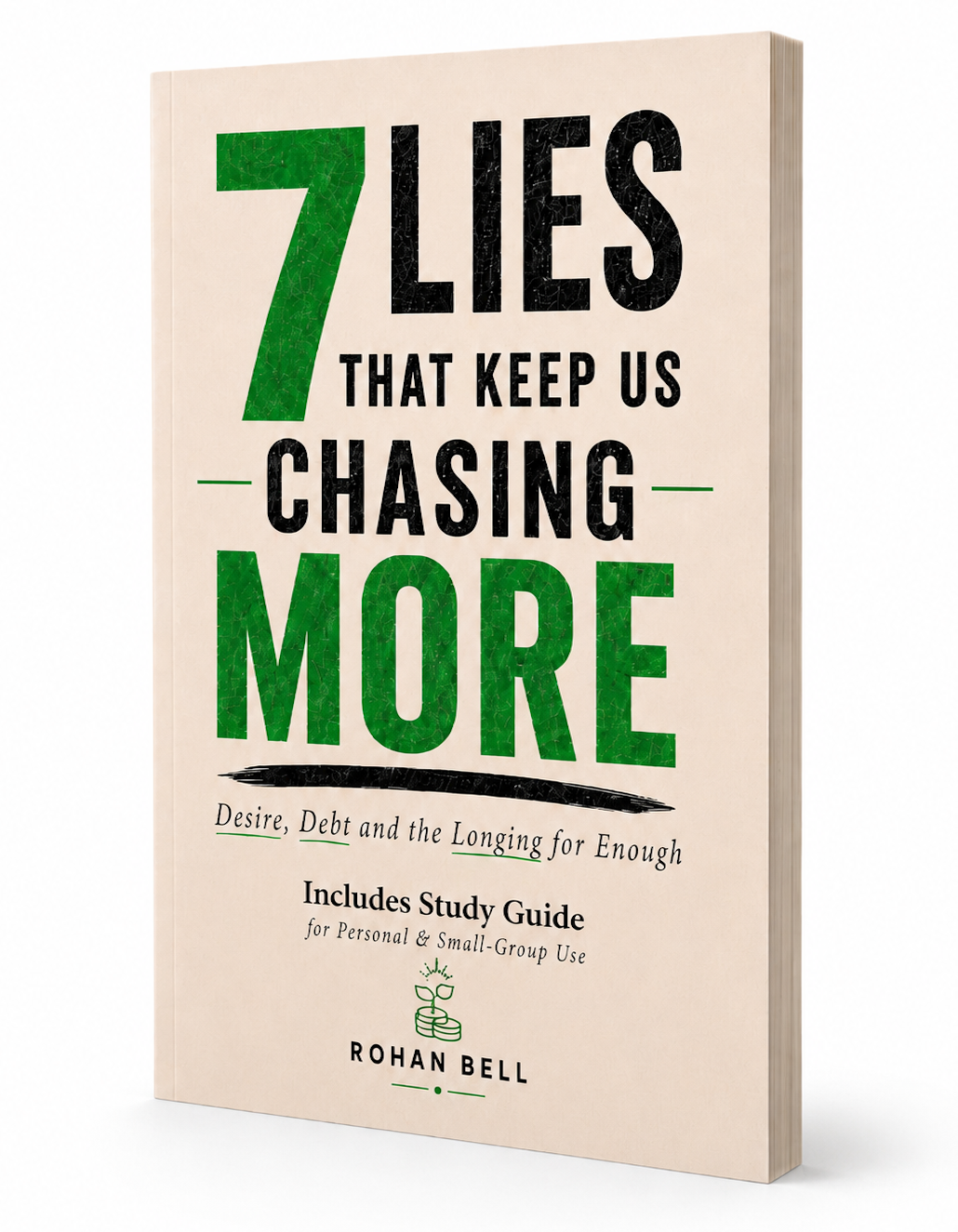
7 Lies That Keep Us Chasing More is a pastoral and practical book for Christians who want to think more faithfully about money, desire, debt, contentment and the longing for enough.
It is not a financial advice book, a budgeting manual or a prosperity formula. It is a discipleship book about the way our hearts are shaped by what we see, want, fear, chase, envy, protect and treasure.
Available Formats
Digital Bundle (A$12.99) (Launch Sale Price A$7.99)
The direct digital bundle includes both the eBook and Premium PDF editions for personal reading and study.
The eBook edition is designed for flexible everyday reading on phones, tablets, eReaders and compatible reading apps. The text adjusts to your screen size and reading settings, making it the best option for portable reading.
The Premium PDF edition preserves the book's fixed-page layout and is ideal for reading on a tablet, laptop, or desktop screen. It is also useful for study, teaching preparation, personal reflection and small-group discussion.
You may print selected pages from the Premium PDF for your own personal use, study, teaching preparation or small-group discussion.
No physical book is shipped with the digital bundle.
Direct eBook Edition (A$7.99) (Launch Sale Price A$4.99)
The direct eBook edition is for readers who want a flexible digital reading format without purchasing through Amazon.
It can be opened in compatible eBook apps and readers such as Apple Books, Kobo, Google Play Books and other EPUB-compatible reading apps. It is designed for convenient reading across devices, with adjustable text size and reading settings.
Premium PDF Edition (A$7.99) (Launch Sale Price A$4.99)
The Premium PDF edition preserves the book’s fixed-page layout for reading, study and reference.
This version is best suited to tablets, laptops and desktop screens, and is especially useful if you want to work slowly through the book, prepare for a group discussion, teach from the material, or print selected pages for personal or small-group use.
This is a digital download. No physical book is shipped.
Kindle Edition (A$7.99) (Launch Sale Price A$4.99)
The Kindle edition is available through Amazon and can be read on Kindle devices or in the Kindle app.
Paperback Edition (A$28.99) (Launch Sale Price A$21.99)
The paperback edition is printed and shipped by Amazon through print-on-demand. Paperback purchases are completed through Amazon, which manages printing, shipping, and customer service.
Most of us know what it feels like to think life would finally feel easier, safer or more complete if we just had a little more.
More income. More margin. More security. More breathing room. More options. More recognition. More comfort. More control over the future.
Some of those desires may be good. Wanting to provide for your family is not greed. Wanting to reduce financial pressure is not selfishness. Wanting a stable home, reliable work, food on the table, and a little more room to breathe is not wrong.
But good desires can become ruling desires. What begins as something we would like can slowly become something we believe we need in order to be okay. A gift can become a measure of worth. A comfort can become a source of identity. A wise goal can become a restless pursuit. A normal need for provision can become a constant fear that there will never be enough.
7 Lies That Keep Us Chasing More is written for ordinary Christians who want to let Jesus reshape the way they think about money, possessions, debt, blessing, generosity and contentment.
It does not shame people who are struggling. It does not pretend that financial pressure is simple. It does not offer easy formulas for complicated situations. Instead, it invites readers to slow down and ask what may be happening beneath the surface.
What are my desires promising me?
What am I afraid will be true if I do not have more?
What has comparison trained me to notice?
What has debt revealed about fear, shame or avoidance?
What am I asking money or possessions to give me?
What would it mean to receive what God gives with gratitude?
What would it look like to trust that Christ is enough?
This book is about the deeper ache of “not enough” and the way Jesus leads us toward freedom.
The Seven Lies
“My life would be better if I had more”
This lie often sounds reasonable. It tells us that peace, security and contentment are waiting just beyond the next purchase, pay rise, upgrade, opportunity or stage of life. But once we begin measuring life by what we lack, gratitude becomes harder, comparison becomes stronger, and enough keeps moving further away.“God is holding out on me”
This lie is as old as the garden. It teaches us to focus on the one tree we do not have until we can no longer see the rest of what God has given. It turns desire into suspicion and asks us to judge God’s goodness by the thing He has not yet provided.“If I want it, I must need it”
Desire is not automatically wrong. God made us with the capacity to long, enjoy, imagine, create and delight. But desire becomes dangerous when it starts defining need for us. This lie blurs the difference between what is truly necessary and what we have been trained to crave.“Money will make me secure”
Money can do some things. It can pay bills, reduce certain pressures, provide options and help us act wisely. But it cannot carry the weight of ultimate security. This lie asks money to do what only God can do, and then leaves us anxious because no amount ever feels quite safe enough.“Good things cannot become dangerous things”
Some of the most powerful idols in our lives begin as good gifts. A home, a career, a dream, a possession, a holiday, a blessing, a plan for the future or the desire to provide for our family can all be good. But good things become dangerous when they begin to rule us, define us, or demand more trust than they deserve.“Blessing is mainly for me to keep”
Blessing was never meant to stop with us. When we treat what we have received as though it exists only for our own comfort, status or security, our hands slowly close. This lie narrows our vision until generosity feels like loss rather than freedom.“Christ is not enough”
This is the lie beneath many of the others. It does not always announce itself directly. It may simply appear as the quiet assumption that we will only be okay once something else is added. But the way of Jesus leads us to a deeper kind of enough: not because every desire disappears or every problem is solved, but because our deepest identity, security and hope are found in Him.
Who This Book Is For
This book is for Christians who feel the pressure of comparison, spending, debt or financial anxiety.
It is for people who want to think about money and possessions as part of discipleship, not just budgeting.
It is for those who are financially pressured, financially stable, or financially blessed but still restless.
It is for anyone who has wondered why having more does not always make them feel more secure.
It is for small groups who want to talk honestly about desire, debt, contentment, gratitude and generosity.
It is for pastors and leaders looking for a thoughtful, biblical and pastoral resource on money and spiritual formation.
It is for readers who want to receive what God gives with gratitude, hold it with open hands, and trust Jesus more deeply.
This Book Will Help You
Recognise the lies that can shape your desires without you realising.
Understand why money is rarely just about money.
Think about debt without shame, denial or simplistic answers.
Notice how comparison narrows your vision.
Distinguish between genuine needs and restless cravings.
See how good gifts can become ruling desires.
Practise gratitude without pretending life is perfect.
Understand generosity as part of freedom, not merely obligation.
Let Scripture reframe the way you think about desire, provision, blessing and enough.
Trust that your deepest security is found in Christ, not in the next thing.
For Personal Reading and Group Discussion
This book is written to be read slowly, not merely consumed quickly.
Money, debt, desire and contentment can touch tender places in us. Some chapters may address practical financial pressures. Others may speak more deeply to comparison, fear, shame, gratitude, generosity or the quiet belief that life is still waiting somewhere ahead of us.
Each chapter opens with an imaginative vignette designed to help readers feel the tension of the lie before moving into biblical reflection, pastoral teaching and practical application.
At the end of each chapter, there is a study guide for personal reflection and small-group discussion.
Each study guide follows the same simple pattern:
Start With The Text
Look Within
Talk It Through
Live It This Week
Pray It Through
It can be used for:
personal reflection
journalling
small-group discussion
discipleship conversations
church courses
sermon preparation
pastoral leadership teams
Christian education settings
A Note About Financial Pressure
This book reflects on money, debt, desire, contentment, and the longing for enough from a Christian-discipleship perspective.
It is not intended to provide professional financial advice, debt counselling, legal advice or personal financial planning.
If you are experiencing serious financial stress, debt pressure, or hardship, please consider speaking with a qualified financial counsellor, adviser, or an appropriate support service in your area. Asking for help is not a failure of faith. It can be a wise, courageous and practical step toward freedom.
A Note from Rohan
I wrote this book because I know what it feels like to carry the weight of financial pressure.
Jill and I know what it is to carry debt, to feel responsible, anxious and ashamed, and to wonder whether things will ever change. I do not write about these issues from a place of judgment or superiority. I write as someone who has had to learn, slowly and imperfectly, that money is rarely only practical. It touches fear, trust, identity, shame, desire, wisdom and hope.
I also know that stories of provision can be encouraging, but they can be painful if they are told too simply. Not every person’s situation changes in the same way. Not every debt story has the same pathway. Not everyone has the same opportunities, income, family support, housing situation, work options or practical resources.
So this book is not a formula.
It is an invitation to let Jesus teach us to see more truthfully.
My hope is that this book helps you recognise the lies that keep us chasing more, bring your desires honestly before God, receive what He gives with gratitude, ask for help where you need it, and discover a deeper freedom than the next thing could ever provide.
Ready to Read?
Choose the format that works best for you.