
7 Biblical Places
That Change How You Read The Bible
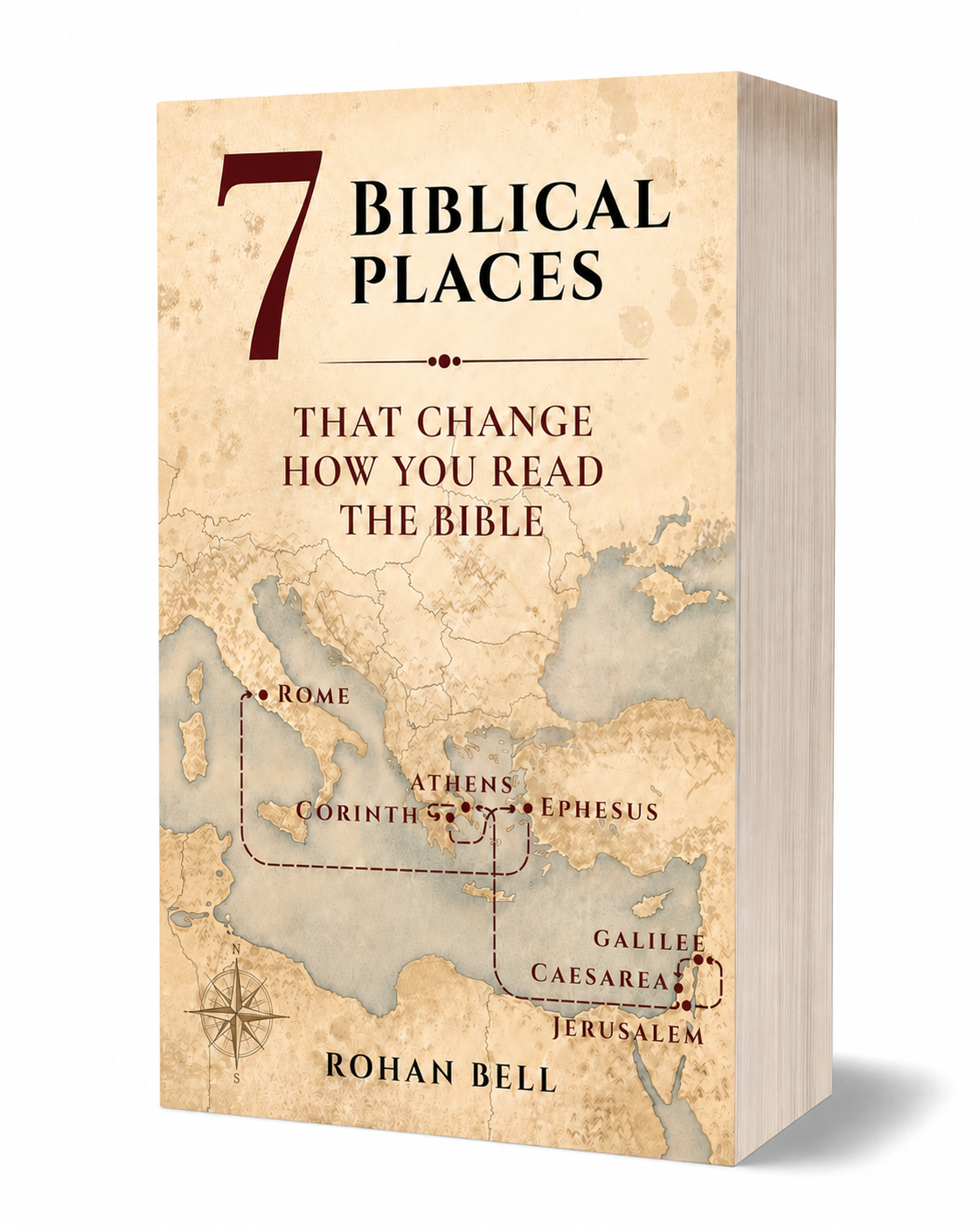
See the places behind the passages and read Scripture with fresh eyes.
The Bible did not happen in a vague religious world. It happened somewhere.
7 Biblical Places That Change How You Read the Bible is a visual, pastoral and historically informed journey through seven places that shaped the world of the New Testament and the story of early Christianity.
It is part biblical reflection, part historical guide, part travel observation and part pastoral invitation. With more than 600 pages and 200+ photographs and images, this book is designed to help ordinary Christians picture the world of Scripture more clearly.
Praise for 7 Biblical Places
“Rohan Bell takes us on an immersive journey into the text, times and topography of the New Testament in a way that makes Scripture come alive.”
Pastor Simon McIntyre
C3 Church Global Exec (Ret.)
BTh, MA
“7 Biblical Places That Change How You Read the Bible is a gem for pastors, teachers and everyday Christians. Bell weaves Scripture, history, theology and practical reflection in a way that brings these places alive.”
Pastor John Finkelde
Founder and Leader
GrowAHealthyChurch.com
“Reading 7 Biblical Places makes each one of them come alive. Rohan has captured the heart and culture, the movements of people and the importance of these places to the Biblical narrative. You can vividly imagine walking the well-trod footsteps of paths of long ago. Read with the eyes of your imagination open, smell the smells, feel the feels, and experience places of significant importance to our understanding of the greatest story ever told.”
Pastor Richard Botta
Founding Pastor - C3 Church Carlingford
TheDiscipleshipGuy.com
Available Formats
Digital Bundle (A$29.99) (Launch Sale Price A$19.99)
The direct digital bundle includes both the eBook and Premium Visual PDF editions for personal reading and study.
The eBook edition is designed for flexible everyday reading on phones, tablets, eReaders and compatible reading apps. The text adjusts to your screen size and reading settings, making it the best option for portable reading.
The Premium Visual PDF edition preserves the book’s fixed-page layout and is the best version for viewing the photographs, images, and visual flow in full colour. It is ideal for reading on a tablet, laptop or desktop screen, and is especially useful for study, teaching preparation, travel preparation and slower visual reading.
No physical book is shipped with the digital bundle.
Direct eBook Edition (A$22.99) (Launch Sale Price A$14.99)
The direct eBook edition is for readers who want a flexible digital reading format without purchasing through Amazon.
It can be opened in compatible eBook apps and readers, such as Kindle, Apple Books, Kobo, Google Play Books, and other EPUB-compatible reading apps. It is designed for convenient reading across devices, with adjustable text size and reading settings.
Premium Visual PDF Edition (A$22.99) (Launch Sale Price A$14.99)
The Premium Visual PDF edition preserves the book’s fixed-page layout and is the best version for viewing the photographs, images, and visual flow in full colour. It is ideal for reading on a tablet, laptop or desktop screen, and is especially useful for study, teaching preparation, travel preparation and slower visual reading.
This is a digital download. No physical book is shipped.
Kindle Edition (A$22.99) (Launch Sale Price A$14.99)
The Kindle edition is available through Amazon and can be read on Kindle devices or in the Kindle app.
Paperback Edition (A$49.99) (Launch Sale Price A$39.99)
The paperback edition is printed and shipped by Amazon through print-on-demand. Paperback purchases are completed through Amazon, which manages printing, shipping, and customer service.
Hardback Edition - Coming Soon (Cost To Be Confirmed)
The hardcover edition is intended as a premium print-on-demand version for readers who want a more substantial physical copy of the book.
With more than 200 full-colour photographs and images throughout, 7 Biblical Places That Change How You Read the Bible is especially suited to slower, relaxed, and enjoyable reading, visual reference, teaching preparation and returning to over time.
Hardcover purchases are completed through Amazon, which manages printing, shipping, and customer service.
Jerusalem. Galilee. Caesarea. Athens. Corinth. Ephesus. Rome.
These are not just names on a map or background locations in familiar Bible stories. They were real places filled with streets, hills, harbours, temples, theatres, marketplaces, crowds, politics, pressure, worship and ordinary human life. Once you begin to see them more clearly, the Bible itself starts to feel less distant.
Stand above Jerusalem and see how close the Mount of Olives, the Temple Mount, Gethsemane and the city really are.
Sit beside the Sea of Galilee and imagine the ordinary world where Jesus called fishermen, taught crowds and announced the kingdom of God.
Walk through Caesarea and see why Paul’s appeal to Caesar was more than a legal detail.
Climb Mars Hill in Athens and understand the world of ideas and idols behind Paul’s famous speech.
Explore Corinth and see why status, wealth, desire and the cross collided so powerfully in the life of the church.
Stand in the theatre at Ephesus and feel the public pressure behind the riot in Acts 19.
Walk through Rome and discover why words like Lord, gospel, peace, witness and kingdom carried such confronting power in the shadow of empire.
7 Biblical Places That Change How You Read the Bible is written for ordinary Christians who want Scripture to feel less abstract and more alive. It is not a dry academic textbook, though it draws deeply on history and context. It is not merely a travel guide, though it includes practical suggestions for readers who may one day visit these places. And it is not simply a book about archaeology, though ancient stones, ruins, roads and cities matter throughout.
The heart of the book is discipleship. Its aim is to help readers picture the world of Scripture more clearly so they can read familiar passages with fresh attention.
The Seven Places
Jerusalem
Jerusalem is not just the city where important biblical events happened. It is the place where kingship, temple, sacrifice, expectation, conflict, worship, death and resurrection all come together.
This chapter helps readers see the city more clearly: the Mount of Olives, Gethsemane, the Temple Mount, the old city, the crowds, the pressure and the intensity of the final week of Jesus’ earthly ministry.
When Jerusalem becomes more than a name, the story of Jesus’ death and resurrection becomes more grounded, more vivid and more confronting.Galilee
Galilee was not a vague countryside backdrop for Jesus’ ministry. It was a real region of villages, roads, fishing boats, hillsides, synagogues, fields and ordinary working people.
This chapter helps readers picture the world where Jesus called disciples, taught crowds, healed the sick, calmed storms, fed thousands and announced the kingdom of God.
To see Galilee more clearly is to remember that Jesus did not begin His ministry in the centres of power, but among ordinary people in ordinary places.Caesarea
Caesarea was a Roman city on the coast, built with ambition, power and empire in mind.
It had a harbour, theatre, palace, aqueduct, hippodrome and all the marks of Rome’s presence in the land. It also became a significant place in the story of the gospel, especially through Peter, Cornelius and Paul.
This chapter helps readers see why Caesarea matters: not only as an impressive archaeological site, but as a place where the gospel crossed boundaries and where Paul’s journey toward Rome took decisive shape.Athens
Athens can easily become a collection of famous names and separate sites: Socrates, Plato, the Parthenon, the Agora, Mars Hill and the unknown god.
But when you see the city as a whole, Paul’s visit in Acts 17 becomes more vivid.
This chapter explores Athens as a city of ideas, beauty, worship, argument, philosophy and spiritual longing. It helps readers understand the world behind Paul’s speech and the challenge of bearing witness to Jesus in a place full of powerful stories and impressive idols.Corinth
Corinth was wealthy, strategic, status-conscious and morally complex.
It sat at a crossroads of trade, travel, ambition and desire. That background helps explain why Paul’s letters to the Corinthians deal so deeply with status, division, sexuality, freedom, worship, weakness and the wisdom of the cross.
This chapter helps readers see that Corinth was not merely a troubled church. It was a church learning to follow a crucified Messiah in a culture shaped by power, performance and social comparison.Ephesus
Ephesus was one of the great cities of the ancient world.
It was home to the famous Temple of Artemis, a vast theatre, busy streets, public religion, spiritual power and commercial life shaped by devotion to the goddess.
This chapter helps readers understand the tension behind Acts 19, the public pressure of the theatre riot, and the spiritual world behind the New Testament’s references to Ephesus.
To see Ephesus clearly is to understand why the gospel was not merely a private belief. It confronted powers, economies, loyalties and fears.Rome
Rome was more than the final destination of Paul’s journey.
It was the centre of the Empire, the city of Caesar, the place where words like lord, gospel, peace and kingdom carried political and spiritual weight.
This chapter helps readers think about Rome not only as a city of monuments and roads, but as the world in which early Christians confessed Jesus as Lord.
To read the New Testament with Rome in view is to see more clearly the courage, cost and hope of Christian witness in the shadow of empire.
Who This Book Is For
This book is for Christians who want to read the Bible with a clearer sense of place, setting and historical context.
It is for people who find biblical geography confusing but want Scripture to feel less distant and abstract.
It is for pastors, teachers and Bible study leaders looking for visual and historical background that can enrich teaching and preaching.
It is for small-group leaders and Christian educators who want to help others picture the world of the Bible more clearly.
It is for Bible students who want an accessible introduction to key New Testament locations.
It is for travellers preparing to visit Israel, Greece, Türkiye or Rome.
It is for readers who may never travel to these places but still want to stand there through description, photographs and imagination.
It is for anyone who has ever read a biblical place name and wondered, “What was it actually like there?”
This Book Will Help You
See seven major biblical places with greater clarity.
Understand how geography, history, culture and empire shaped the world of the New Testament.
Picture familiar Bible stories in their real-world settings.
Read the Gospels, Acts and Paul’s letters with fresh attention.
Understand why Jerusalem, Galilee, Caesarea, Athens, Corinth, Ephesus and Rome matter.
Connect biblical passages with landscapes, ruins, roads, harbours, theatres and cities.
Prepare more thoughtfully if you plan to visit these places.
Reflect more deeply if you have already been there.
Teach and preach with a richer sense of context.
Read Scripture with greater imagination, humility and wonder.
For Personal Reading, Teaching and Travel Preparation
This book is designed to be read slowly and visually. Each chapter is written as a journey through one place, combining biblical reflection, historical context, personal observation, photographs and pastoral application.
Each chapter can be read on its own, or the whole book can be read as a journey from Jerusalem to Rome.
It can be used for:
personal Bible reading
visual study and reflection
sermon preparation
teaching background
Bible college or discipleship settings
travel preparation
reflection after visiting biblical sites
small-group or church-course background reading
deepening your understanding of the New Testament world
A Note About the Photographs and Images
This book includes more than 200 photographs and images. They are not included merely as decoration. They are part of the way the book helps readers see the places behind the passages.
Some images show landscapes, ruins, streets, churches, harbours, theatres and archaeological remains. Others help readers imagine the ancient world more clearly.
The Premium Visual PDF and Paperback editions are the best way to experience the book's full visual layout. The eBook and Kindle editions are designed for flexible reading, so the placement and size of images may vary depending on your device or reading app.
A Note from Rohan
I wrote this book because visiting these places changed the way I read the Bible.
Again and again, I found myself standing somewhere I had read about for years and thinking, “So that is what it looked like.” “So that is why that story happened there.” “So that is what they would have seen.”
Jerusalem was smaller than I imagined, and far more intense. Galilee was quieter, more beautiful and more ordinary in the best sense of that word. Caesarea felt more Roman than I had expected. Athens was more dramatic. Corinth was more revealing. Ephesus was grander and more spiritually charged. Rome helped me understand the world of the New Testament far more than I had anticipated.
Of course, you do not need to travel in order to read the Bible faithfully. But understanding place can help us read with better imagination and attention.
The Bible happened somewhere. It happened in real cities, beside real waters, along real roads, among real crowds, under real pressure and in the middle of real human life.
My hope is that this book helps you see those places more clearly, read familiar passages with fresh eyes, and follow Jesus with a deeper sense of the world into which the gospel first came.
Ready to Read?
Choose the format that works best for you